As we know, Ancient Greek life was very different then life today. The world was not modernized and industrialized the way it is now. In Ancient Greece, individuals worked hard every day to feed themselves and to obtain goods that are necessary for every day survival. Another important part of life during this time was theatre. Theatre was one of the only forms of entertainment for people and it was also a place where many gathered to socialize. Here is an excerpt on ancient Greek life.
"Men if they were not training in military, or discussing politics they went to the Theatre for entertainment. To watch dramas that they could relate to, including tragedies and comedies. These often involved current politics and gods in some form. It is thought that women were not allowed to watch theatre or perform at the theatre, although male actors did play women roles.
Lives of Women in Ancient Greece were closely tied to domestic work, spinning, weaving and other domestic duties. They were not involved in public life or in politics. The live were normally quite confined to the house although one public duty was acting as a priestess at a temple.
Children in ancient Greece usually occupied their time playing with toys and games." (Ancient Greek)
To read more about ancient Greek lifestyle visit http://www.ancientgreece.com/s/Life/ as it was very helpful for me to obtain knowledge about life during these times.
Wednesday, April 30, 2014

Wednesday, May 15, 2013
Spohocles Life
"Born in 495 B.C. about a mile northwest of Athens, Sophocles was to become one
of the great playwrights of the golden age. The son of a wealthy merchant, he
would enjoy all the comforts of a thriving Greek empire. He studied all of the
arts. By the age of sixteen, he was already known for his beauty and grace and
was chosen to lead a choir of boys at a celebration of the victory of Salamis.
Twelve years later, his studies complete, he was ready to compete in the City
Dionysia--a festival held every year at the Theatre of Dionysus in which new
plays were presented.
In his first competition, Sophocles took first prize--defeating none other than Aeschylus himself. More than 120 plays were to follow. He would go on to win eighteen first prizes, and he would never fail to take at least second......Of Sophocles' more than 120 plays, only seven have survived in their entirety. Of these, Oedipus the King is generally considered his greatest work. This tragedy of fate explores the depths of modern psycho-analysis as Oedipus unwittingly kills his father and marries his mother in an attempt to avoid the very prophecy he ultimately fulfills." (Sophocles)
For more information on Sophocles life - http://www.imagi-nation.com/moonstruck/clsc1.htm was a great source of information.
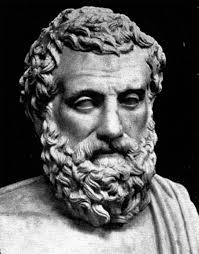
In his first competition, Sophocles took first prize--defeating none other than Aeschylus himself. More than 120 plays were to follow. He would go on to win eighteen first prizes, and he would never fail to take at least second......Of Sophocles' more than 120 plays, only seven have survived in their entirety. Of these, Oedipus the King is generally considered his greatest work. This tragedy of fate explores the depths of modern psycho-analysis as Oedipus unwittingly kills his father and marries his mother in an attempt to avoid the very prophecy he ultimately fulfills." (Sophocles)
For more information on Sophocles life - http://www.imagi-nation.com/moonstruck/clsc1.htm was a great source of information.
Thursday, May 2, 2013
Oedipus Rex Summary
Oedipus Rex is a greek tragedy written by Sophocles. To begin the play a plague has stricken the city of Thebes. Oedipus, the king of Thebes ordered his brother - in - law Creon to visit an oracle to find out how to help the city. The oracle stated that the plague will end when the murderer of King Laius is found and dismissed. To find out more about the murder oedipus sent out for the blind prophet Tiresias. Oedipus did not want to believe Tiresias that he was the one who had killed king Laius, so Oedipus accuses Creon and Tiresias of conspiring against his life, and charged Tiresias with insanity. Now angered before leaving the stage, Tiresias left Oedipus with one more riddle saying that the murderer of Laius will turn out to be both father and brother to his own children, and the son of his own wife. Soon after Tiresias leaves Oedipus' wife Jocasta helped explain the murder of King Laius to him to help solve the mistery. After hearing about his death, Oedipus believes that he could be the murderer of Laius. After calling upon a local shepherd he is informed that he was the son of Laius and that he was sent to be killed as a new born child. He had also come to realize that he also was the murderer of his father and the husband of his own mother! Realizing who he is and who his parents are Oedipus flees the scene while gouging his own eyes out. While bleeding he begs to be exiled and asks Creon to take care of his young children.
Tuesday, April 30, 2013
Antigone
"Oedipus Rex" written by Sophocles was one of the three outstanding plays in the "Oedipus Cycle" trilogy. "Antigone", is the last play in his trilogy and is an impressive piece of work written by Sophocles. Here is an online verson of the play for those who are interested to keep reading. http://classics.mit.edu/Sophocles/antigone.html (Jebb R.C.)
Oedipus Rex Movie Clip
Although animated, this short video clip provides a synopsis of what happened during the play "Oedipus Rex"
.
Greek Gods
Here are the names, as well as some photos of Greek Gods and Godesses. For more information about the history and story behind each God and Godess http://www.infoplease.com/ipa/A0881990.html. (The Olympian Gods)
Zeus

Hera

Poseidon

Hades

Apollo

Zeus
Hera
Poseidon
Hades
Apollo
Short Story Essay Literary Devices 2/20/13
Characterization is a
popular literary element that authors use to show the common gestures, actions
and personality traits of characters in their writing. Edgar Allen Poe and Ernest Hemingway both use
other formal elements to help develop such characterization in their stories.
In "The Cask of Amontillado" by Edgar Allen Poe, and “A Clean,
Well-Lighted Place” by Ernest Hemingway both authors use irony, setting, and
point of view to all create better characterization in their stories.
Poe uses many examples of irony in "The Cask of
Amontillado" to help form characterization in his writing. The name
Fortunado can be viewed as someone fortunate, or someone who has wealth, and it
is soon discovered that Fortunados fate is not “fortunate”. Another example of
dramatic irony shown by Poe is how Fortunado states that a cough will not kill
him, "Enough, the cough is a mere nothing; it will not kill me. I shall
not die of a cough."(Poe 6) As a
reader, it is understood that although his cold may not kill him that something
else will. This irony used by Poe helps give the reader more insight about the
character and can also foreshadow their actions. Ernest Hemingway also uses
irony to characterize in “A Clean, Well-Lighted Place”. A clear example of
irony used is the fact that both the old man and the "older" waiter
prefer to stay out late while the young man in the story prefers to go home
early. This shows how although typically a younger man would enjoy staying out
later a lonely old man would rather stay at the bar with no friends then to
leave and be on his own.
The setting of "The Cask of Amontillado" is
used by Poe to help form the demeanor of his characters. Showing where their
actions are being held help to understand more about the characters. Fortunado
is originally found during the carnival season wearing cloths similar to a
jester. You can infer from this how Fortunado is a quite foolish character and
may be gullible to others. The rest of the story takes place in the cold, dark
and musty catacombs of the Montresors. This
setting draws to conclusions that Montressor is a dark and shady person with no
good in mind. The dark and damp setting of the catacombs also ties very well
with the conclusion of the story as Montressor has taken Fortunado to this
unpleasant place as his death bed. Setting is also used to create better
characterization for Ernest Hemingway as well. Taking place very late at night
in a café with not a soul left besides the waiters helps to grasp the
loneliness of the man still drinking alone. This setting truly makes the reader
realize how this man has nothing else going for him in his life.
Another important literary element used to build
characterization is the point of view. This is important when creating a
character because the narrator’s point of view plays a large role with what we
know about a specific character and how we feel about them. This is important
in "The Cask of Amontillado" because with Montresor as the narrator
we may assume although we never know what Fortunado did so badly to deserve a
sentence of death. This shows how Montresor is a shady person to trick
Fortunado to his death while acting as a friend. Point of view also plays a large
role in “A Clean, Well-Lighted Place” as it does not tell you what hardships
the old man may be facing in his life in which he does not want to leave the
café.
Subscribe to:
Posts (Atom)